How to work through negative emotions
Having difficulty finding your safe space? MUK QI EN explores the possible solutions together with Tammie Ong, a teen who can’t live without a feeding tube.
Tammie Ong, 18, a student from Singapore Polytechnic, was diagnosed with four chronic illnesses when she was just 17. Her life now depends on a feeding tube to receive proper nutrition.
Reaching her diagnosis, however, was a difficult journey. Doctors referred her to a psychiatrist because they didn’t believe her. “It was very frustrating because they thought that I had an eating disorder,” Miss Ong says.
One of the lowest points in her life was getting told she needed a feeding tube. “It was a very big lifestyle change because I was still in school and it was very troublesome,” she says. “I was in and out the hospital the whole entire time and it was just very frustrating.”
Despite having a strong network of support, Miss Ong keeps most of her troubles to herself. “I think my main coping mechanism is really just crying to myself because I don't like to, in a way, burden other people.”
Even so, Miss Ong is able to remain positive as she finds strength in family, friends, social media and crafting.
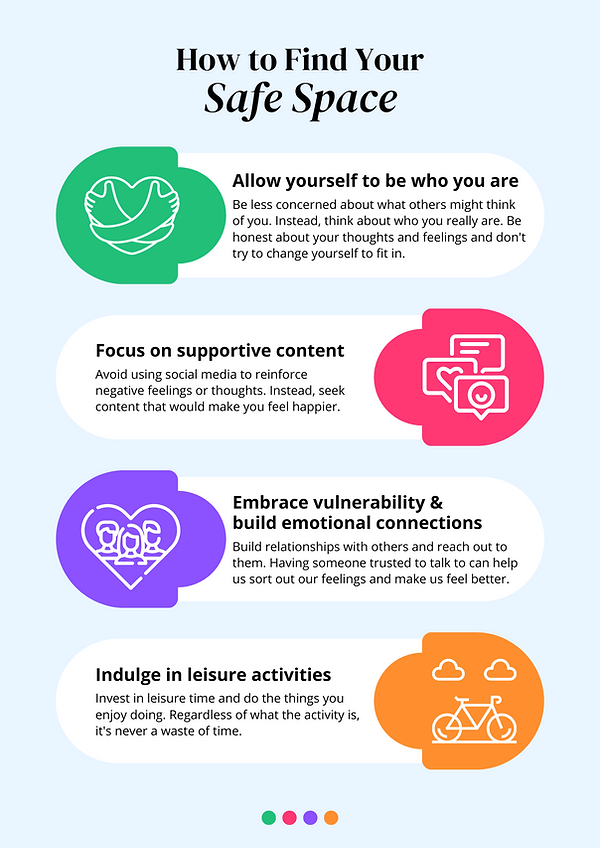
Below are some tips on how you can work through negative emotions by creating your own safe space.
-
Allow yourself to be who you are
More people today are concerned about how others think about them. Mr Donavan Teo, 37, a counsellor at Ngee Ann Polytechnic, says, “They are less willing to say ‘what I think about myself, how do I see myself’.”
It’s exhausting and emotionally draining to constantly put up a front or bottle up your emotions. According to an article by HealthHub, “Sharing our thoughts and feelings with others can help us realise that we are not alone.”
“You shouldn't try to change yourself just to fit in with other people because there's only one you,” Miss Ong says. “You are unique in your own way.”
2. Focus on supportive content
Immersing yourself in content that’s negative, or that reflects the negative emotions you feel at that moment can create a space that doesn’t allow you to achieve complete rest.
“For some of my students, or clients, they kind of look at social media that reinforces the way they're feeling,” Mr Teo says. “They say birds of a feather flock together.”
As somebody who shares a lot about themselves on social media, Miss Ong receives both support and backlash. But she doesn’t let the hate get to her. She ignores them and in doing so, realised how supportive the rest of the community is, even making friends with some of them.
3. Family matters
Though Miss Ong has a small circle of friends, she goes by this saying, “[A] family stays forever but friends come and go.”
When things seem overwhelming, Miss Ong seeks solace in her family. “I will go to my siblings for help because I trust my siblings,” she says. “My family is the most important to me.”
In the beginning, Miss Ong confided in her siblings because her parents didn’t understand the way she felt. “My siblings are that bridge between me and my parents… to help them understand,” she says.
According to The Straits Times, a national study found that “building relationships were important protective factors, among others, against self-harm and suicidal thoughts for young people in Singapore”.
4. Indulge in leisure activities
Leisure time can look different for everybody. It could be devoting time to your hobby, physical exercise, or even binge-watching your favourite drama.
For Miss Ong, crocheting distracts her from the symptoms she experiences. She has even set up a small business.
Having a safe space, an anchor, prevents negative emotions from taking over. “When we have lesser of an anchor, a kind of security, you are more prone to wherever the wind blows,” Mr Teo says.